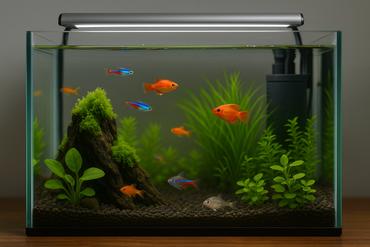
TRENDING: COMPACT AQUARIUM EQUIPMENT

The Evolution of Nano Filtration Systems
Filtration is the heart of any aquarium, but in a small tank, a bulky internal filter can take up precious swimming space and ruin the visual scale of the environment. The latest trend in compact filtration focuses on maximizing surface area for beneficial bacteria while maintaining a low profile. Internal corner filters and "hang-on-back" (HOB) slim filters are currently leading the market for hobbyists who want efficiency without the clutter.
In 2026, we are seeing a significant shift toward customizable media in small formats. Manufacturers like Oase and Fluval have introduced slimline HOB units that move away from the traditional "disposable cartridge" model. This is a massive win for the environment and the aquarium's stability, as it allows hobbyists to use high-quality ceramic rings and specialized sponges that host far more beneficial bacteria than a thin layer of carbon-infused floss.
- Slimline Hang-On-Back Filters: Modern HOB filters are thinner than ever, often featuring adjustable flow rates which are essential for small tanks containing long-finned species like Betta fish. Models like the Oase BioStyle or the Fluval C-Series provide multi-stage filtration that rivals larger canister units.
- Internal Nano Sponges: For shrimp breeders, the trending choice is the ultra-compact air-driven sponge filter. These provide excellent biological filtration and a grazing surface for fry without the risk of sucking small inhabitants into an intake.
- All-In-One (AIO) Chambers: Many modern rimless tanks now come with built-in back chambers that hide the heater and media, creating a seamless look that is increasingly popular for minimalist office setups.
- Surface Skimmers: Once reserved for large saltwater setups, nano-sized surface skimmers are now a trending add-on for planted tanks. They remove the oily biofilm that can accumulate on the surface of small water volumes, improving oxygen exchange.
A common mistake beginners make is choosing a filter with a flow rate that is too aggressive for a small volume of water. While you want high turnover for water quality, a "washing machine" effect will stress your fish. Look for units that allow you to baffle the output or choose a filter specifically rated for your gallonage. To learn more about maintaining your water quality, check out our guide on the importance of the nitrogen cycle.
High-Intensity Compact Lighting for Planted Nano Tanks
Gone are the days when small tanks were limited to plastic plants or low-light mosses. The miniaturization of LED technology has introduced high-PAR (Photosynthetically Active Radiation) lighting that clips onto the side of the glass. These lights are often programmable, allowing users to simulate sunrise and sunset, which reduces stress on the inhabitants and helps prevent algae blooms. In the world of compact equipment, "pendant" style lights like the AI Prime 16HD or the Fluval Nano Plant LED have become the gold standard.
When selecting compact lighting, it is important to match the spectrum to your inhabitants. For a planted nano tank featuring species like Dwarf Hairgrass or Anubias Nana Petite, you need a full-spectrum LED. However, if you are keeping a fish-only setup, a simpler, dimmable LED will suffice. The trend is moving toward lights with a higher concentration of red and blue diodes, which not only assist in photosynthesis but also make the colors of fish like Ember Tetras or Neon Tetras "pop" with incredible intensity.
Intermediate hobbyists are also looking for smart-integrated features. Being able to control your tank’s photo-period from a smartphone app is no longer a luxury reserved for 100-gallon reefs; it is now standard for many high-end nano lights. This precision helps in managing the delicate balance of a small tank, where even an extra hour of light can lead to a sudden explosion of green water. Furthermore, these smart lights often feature "acclimation modes" which slowly increase intensity over several weeks, preventing light shock for new plants or sensitive corals in a nano reef.
Precision Heating and Temperature Stability
Temperature stability is perhaps the biggest challenge in a compact aquarium. Because there is less water volume, the temperature can fluctuate rapidly based on the ambient room temperature. The trending solution is the use of preset miniature heaters and electronic controllers. Traditional glass heaters are often too long for nano tanks, leading to the popularity of shatterproof polymer heaters that are less than five inches long, such as the Hygger Mini or the Cobalt Neo-Therm.
The risk with small heaters is often "sticking" in the on position. In a 5-gallon tank, a failed heater can raise the temperature to lethal levels in under an hour. This has led to the rise of secondary temperature controllers, like those from Inkbird, which serve as an external brain. You plug your heater into the controller, and it cuts the power if the probe detects a temperature outside your set range. This "redundancy" is a hallmark of the intermediate hobbyist and is highly recommended for anyone keeping expensive shrimp or delicate nano fish.
- Flat Profile Heaters: These are designed to be tucked behind hardscape or hidden in a filter compartment, maintaining the "invisible" equipment aesthetic.
- Digital Thermostats: Many new compact heaters include a digital readout on the cord, allowing you to check the status without squinting at a tiny thermometer inside the tank.
- USB-Powered Options: For ultra-small "pico" tanks (under 3 gallons), USB-powered heating elements have emerged, though these are generally only suitable for very stable indoor environments.
When stocking a heated nano tank, consider species like Sparkling Gouramis or Endler’s Livebearers. These fish thrive in the stable, warm temperatures (around 78°F) that a high-quality compact heater provides. Always place your heater near the filter intake or outlet to ensure the warmed water is circulated evenly throughout the small space, preventing "cold spots" in the corners of the tank.
Compatibility and Care in Compact Ecosystems
Just because the equipment is small does not mean the care requirements are diminished. In fact, compact tanks require more discipline than large ones. The margin for error is slim. Compatibility becomes a spatial issue as much as a behavioral one. In a 10-gallon tank, there is nowhere for a bullied fish to hide, making your choice of inhabitants and their equipment-driven environment critical. Overcrowding is the number one cause of failure in nano tanks, as the waste produced quickly exceeds the capacity of even the best compact filters.
When planning your stocking, consider the "bioload" capacity of your compact equipment. For a thriving community, consider these combinations that have proven successful for both beginners and intermediate keepers:
- The Invertebrate Haven: Neocaridina Shrimp (Cherry Shrimp) paired with Nerite Snails. These species have a low bioload and thrive with sponge filtration, which provides plenty of surface area for them to graze on biofilm.
- The Micro-School: A group of 6-8 Chili Rasboras or Celestial Pearl Danios. These fish stay under an inch and appreciate the gentle flow of modern slimline filters. They also look stunning under the high-CRI (Color Rendering Index) lighting typical of modern nano LEDs.
- The Centerpiece: A single Dwarf Puffer. While they require high-quality filtration due to their messy eating habits, they are perfect for a heavily decorated 5-to-10-gallon setup with a powerful HOB filter.
- The Classic Betta: A single Betta Splendens in a 5-gallon tank. Ensure your filter flow is adjustable, as Bettas can struggle to swim in the high-flow environments created by some power filters.
A common beginner pitfall is over-cleaning the compact filter. Because the media is small, it holds a limited colony of bacteria. Never rinse your nano filter media in tap water; the chlorine will wipe out your beneficial bacteria instantly. Always use dechlorinated tank water during your water changes to preserve the biological balance. For further reading on keeping your inhabitants healthy, explore our tips on how to properly stock your aquarium.
Advanced Nano Tech: Automation and Monitoring
One of the most exciting trends in 2026 is the democratization of aquarium automation. Previously, "smart" aquarium tools were expensive and bulky. Today, compact Smart Wi-Fi power strips and miniature Auto Top-Off (ATO) systems are accessible to everyone. In a small aquarium, evaporation is a major concern. As water evaporates, the concentration of minerals and salts increases, which can stress fish. A compact ATO, such as the XP Aqua Duetto, uses a tiny optical sensor to monitor the water level and automatically adds fresh water from a reservoir, keeping the salinity and mineral content perfectly stable.
We are also seeing the rise of AI-assisted monitoring. Compact sensors that measure pH, temperature, and even ammonia levels can now send alerts directly to your smartphone. For the intermediate hobbyist, this data is invaluable. It allows you to see the "rhythm" of your tank—how the pH dips at night when plants stop photosynthesizing, or how the temperature might spike when the afternoon sun hits the room. Using this information, you can adjust your compact equipment (like turning down the light or adjusting the heater) to compensate before a problem becomes a crisis.
Moreover, the integration of CO2 systems has shrunk. Miniature CO2 regulators that fit onto small disposable cartridges or Sodastream cylinders have made it possible to grow demanding "carpeting" plants like Cuba (Hemianthus callitrichoides) in a 5-gallon tank. This was nearly impossible a decade ago without a massive, unsightly gas tank sitting next to the aquarium. These compact gas systems, when paired with a smart solenoid, ensure your plants get exactly what they need during the day and nothing when the lights go out.
Actionable Maintenance Tips for Small-Scale Success
If you are transitioning to compact equipment, the most important tool in your kit is a high-quality water testing set. Small changes in ammonia or nitrate are magnified in small volumes. Beyond testing, your physical setup will dictate your success. Use "nano-scale" hardscape—small pieces of driftwood and stone—to maintain a sense of perspective. Large rocks will displace too much water, leaving less room for your fish to swim and reducing the oxygenation capacity of the tank.
Maintenance should be frequent but minimal. Instead of a 50% water change once a month, aim for a 10-15% change every week. This consistency prevents the "swing" in water chemistry that can be fatal to sensitive species like Crystal Red Shrimp. Additionally, ensure that your compact equipment is easily accessible. If you have to tear apart your entire aquascape just to reach the filter sponge, you are less likely to perform the necessary maintenance. Use magnetic algae scrapers designed for thin glass to keep your viewing panes clear without getting your hands in the tank every day.
Another "pro tip" for compact tanks is the use of pre-filter sponges on your filter intakes. These tiny sponges prevent small fish and shrimp from being sucked into the filter and provide an extra layer of mechanical filtration. They are easy to pop off and rinse during your weekly water change. By combining these practical habits with the latest trending equipment, you ensure that your nano tank isn't just a "starter" project, but a long-term, thriving work of art.
Takeaway: Embracing the Future of Small-Scale Fishkeeping
The trend toward compact aquarium equipment is more than just a fashion statement; it is a movement toward making the hobby accessible to everyone, regardless of their living situation. By utilizing slimline filters, high-output LED clips, and precision heaters, you can create a professional-grade ecosystem in a space no larger than a shoebox. The technological advancements of 2026 have effectively removed the "difficulty barrier" that used to plague small tanks, but they still require a mindful approach to biology and chemistry.
Remember that success with compact equipment relies on consistency, careful stocking, and a commitment to regular monitoring. The smaller the tank, the more the hobbyist’s skill and attention to detail shine through. We encourage you to explore the latest nano-tech options, from smart sensors to ultra-efficient filters, and share your small-scale success stories with our community. Ready to start your next project? Keep researching, keep testing, and enjoy the intricate beauty of the nano world. The future of fishkeeping is small, smart, and more vibrant than ever before. Visit our community forums to see what other nano-enthusiasts are building and get inspired for your next desktop masterpiece!


MOST RECENT ARTICLES