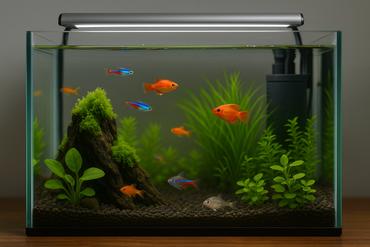
SMART TANK TECHNOLOGY IS THE FUTURE OF THE AQUARIUM HOBBY

The Evolution of the Connected Aquarium: From Analog to Digital
The transition from "dumb" equipment to smart technology represents the most significant shift in the hobby since the invention of the hang-on-back filter. In the past, a heater failure or a pH swing could go unnoticed for days, often resulting in the loss of sensitive species. Today, smart controllers and Wi-Fi-enabled devices act as a 24/7 digital sentry for your tank. This evolution is driven by the Internet of Things (IoT), where every component—from your return pump to your protein skimmer—can communicate with a central hub.
For the average hobbyist, this technology usually begins with a central controller or a series of app-integrated devices. These systems allow you to monitor parameters and control hardware from your smartphone. Whether you are keeping a community of hardy beginner freshwater fish like Neon Tetras or a more complex saltwater reef filled with Acropora corals, the ability to receive a push notification the moment your temperature fluctuates is a literal lifesaver. This shift toward connectivity addresses the primary reason people leave the hobby: the frustration of losing livestock due to preventable environmental crashes.
The core of the smart tank is the "Central Brain." Systems like the Neptune Apex or GHL Profilux have paved the way, but we are now seeing more affordable, entry-level options that focus on specific tasks. For example, a smart power bar can monitor the wattage of your equipment. If your return pump starts drawing more power than usual, it may indicate a clog or mechanical failure. The system can alert you before the pump burns out entirely, saving you money and protecting your fish from oxygen depletion.
- Remote Monitoring: Check on your tank's health from work, the grocery store, or while on a tropical vacation.
- Automated Alerts: Receive instant warnings for leaks, power outages, or equipment malfunctions that would otherwise be invisible.
- Data Logging and Trend Analysis: Track trends over months to see how your maintenance routine affects water quality, allowing for proactive rather than reactive care.
- Redundancy: Smart systems allow for "if/then" programming—for example, "If the temperature exceeds 82 degrees, turn off the heater and turn on the cooling fans."
Automated Lighting and the Natural Rhythm of Aquatic Life
One of the most practical and visually stunning applications of smart technology is in aquarium lighting. Traditional timers are limited to basic "on/off" functions, which can be jarring for fish. Imagine being in a pitch-black room and having a high-intensity stadium light flicked on instantly. This causes a "startle response" in fish, leading to stress and physical injury as they bolt into the glass or decorations. Smart LED systems allow for "ramp up" and "ramp down" periods that mimic a natural sunrise and sunset.
This isn't just for aesthetic appeal; it significantly reduces stress for inhabitants. Species like the Discus or various types of skittish Rasboras are particularly sensitive to light changes. By using a smart controller to gradually increase intensity over 60 minutes, you provide a more natural transition that encourages normal circadian rhythms and breeding behaviors. In the wild, light intensity changes slowly; smart technology finally allows us to replicate this in our living rooms.
Furthermore, smart lighting allows for total spectrum customization. You can boost the blue and red wavelengths to make the colors of your Boesemani Rainbowfish or Glowlight Tetras pop, or adjust the PAR (Photosynthetically Active Radiation) output to ensure your live plants are getting exactly what they need without fueling an unwanted algae bloom. Modern apps even allow you to simulate weather patterns. While "thunderstorm mode" might be a fun gimmick to show friends, the ability to simulate moon phases is genuinely beneficial for those looking to breed certain species that rely on lunar cues to spawn.
For intermediate hobbyists venturing into the world of high-tech planted tanks, smart lighting is essential. You can program a "siesta" period in the middle of the day to help manage CO2 levels and discourage algae, or create a specific "viewing profile" for the evenings that enhances the fluorescent pigments in your fish without contributing to the overall photoperiod that drives plant growth.
Precision Dosing and the Science of Water Chemistry Stability
Stability is the holy grail of fishkeeping. In a small glass box, chemistry can change rapidly, often with disastrous results. This is where smart dosing pumps and automated testing kits have revolutionized the experience for intermediate hobbyists. In saltwater tanks, maintaining consistent Calcium, Alkalinity, and Magnesium levels is critical for coral skeletal growth. In freshwater planted tanks, consistent liquid fertilization—carbon, iron, and potassium—is the key to lush growth and preventing "melt."
Smart dosing pumps can be programmed to deliver minute amounts of supplements throughout the 24-hour cycle, rather than one large, disruptive "shock" dose in the morning. This prevents the "seesaw" effect of nutrient levels that often leads to plant death or coral bleaching. More advanced systems, such as the Ion Director or the Trident, can now even test your water parameters automatically and adjust the dosing regimen based on real-time results. If the system detects a drop in Alkalinity, it simply tells the pump to add a few more milliliters. This is a level of precision that was previously impossible for a human to maintain manually.
For those keeping sensitive species such as Crystal Red Shrimp or German Blue Rams, this level of precision is invaluable. These animals require very specific water parameters, and even a slight shift in GH (General Hardness) or pH during a water change can trigger a molt or a disease outbreak. Smart technology allows for "Auto Water Changes" (AWC), where the system slowly removes a tiny amount of old water and replaces it with new, pre-heated, and buffered water throughout the day. This eliminates the "swing" associated with a massive weekly water change and keeps the environment incredibly stable.
Common beginner mistakes often involve "chasing numbers"—adding chemicals to hit a specific pH or hardness level only to have it bounce back. Smart technology helps avoid this by showing you the trend line. Instead of seeing a single data point from a liquid test kit, you see a graph. You might realize that your pH naturally dips at night when plants stop photosynthesizing, which is a normal biological process, preventing you from adding unnecessary and harmful pH buffers.
Smart Feeding: Nutritional Management and Waste Control
Overfeeding is perhaps the number one cause of aquarium failure for beginners. It leads to ammonia spikes, clogged filters, and unsightly pest snail or algae outbreaks. Smart automatic feeders solve this by delivering precise portions at specific times of the day, ensuring your fish are fed without polluting the water column. However, the "smart" aspect goes far beyond a simple rotating barrel.
Unlike old-fashioned mechanical feeders, smart versions can be controlled via an app. If you notice your fish looking a bit sluggish or if you have skipped a scheduled maintenance session, you can instantly reduce the feeding amount or skip a meal entirely from your phone. You can also set multiple small feedings, which is ideal for "grazer" species like African Cichlids (Mbuna) or certain types of Saltwater Tangs and Anthias that have high metabolisms and do better with five or six tiny meals rather than one large feast that most of the fish miss.
- Moisture Control: Many smart feeders include internal heaters or fans to keep flake and pellet food dry, preventing the "clumping" that often leads to feeder failure and rotten food falling into the tank.
- Holiday Mode and Logic: You can program the feeder to interact with other equipment. For example, "When the feeder is active, turn off the surface skimmer and high-flow powerheads for 10 minutes" so the food doesn't get sucked into the filter before the fish can eat it.
- Camera Integration: Some feeders now include HD cameras. This allows you to verify that your fish are actually eating, which is the best way to monitor for early signs of illness or bullying.
For the intermediate hobbyist, smart feeding also allows for "targeted nutrition." You can have different feeders for different types of food—one for sinking pellets for your Clown Loaches and another for floating flakes for your Hatchetfish. This ensures that all levels of the water column are addressed without the waste associated with "broadcasting" food and hoping for the best.
Compatibility, Maintenance, and Vital Care Considerations
While smart technology makes the hobby significantly more manageable, it is not a "set it and forget it" solution. A common pitfall for both beginners and intermediate keepers is relying too heavily on the tech and neglecting basic husbandry. Technology should augment your care, not replace the keen eye of the aquarist. No sensor can perfectly replicate the intuition you gain from watching your fish daily.
Compatibility between different brands of smart gear is a major consideration. When starting, it is often wise to stick within one "ecosystem" (using the same brand for lights, pumps, and feeders) so they can all be controlled from a single dashboard. If you mix and match, you may end up with a dozen different apps, which can lead to "app fatigue" and make it harder to coordinate your equipment during maintenance. Many users now look for "Matter" or "Thread" compatibility, which are emerging standards for smart homes that may eventually unify aquarium tech.
Regarding maintenance, smart sensors (like pH, Salinity, or ORP probes) require regular calibration to remain accurate. A probe that hasn't been cleaned or calibrated in six months might give a false reading, leading you to make unnecessary—and potentially harmful—adjustments to your water chemistry. This is a "garbage in, garbage out" scenario. Always double-check your digital readings with a high-quality manual test kit at least once a month to ensure your sensors are on point. Understanding the importance of water changes remains foundational; no amount of technology can replace the need for fresh, clean water and the removal of dissolved organic compounds that sensors might not detect.
Another care consideration is the "fail-safe" state of your equipment. When choosing smart heaters or pumps, look for those that have a "fail-off" or "fail-to-last-setting" feature in case of a Wi-Fi outage. In the event of an internet failure, your equipment should continue to run on its internal schedule. If your "smart" heater requires a cloud connection to know when to turn off, a simple router reboot could result in "fish soup." Always prioritize hardware that has local processing power.
Finally, consider the power requirements. A fully automated smart tank can have dozens of power bricks. Proper cable management and the use of "drip loops" are non-negotiable. Water and electricity are a dangerous mix, and smart equipment is just as susceptible to salt creep and humidity as traditional gear. Mount your controllers in a dry cabinet away from the sump or the top of the tank to prolong their lifespan.
Common Pitfalls: When Technology Meets Biology
The most frequent error in the "smart era" is information overload. New hobbyists often see a minor dip in a digital reading and panic, adding chemicals or changing settings to "fix" a problem that might just be a temporary fluctuation or a sensor glitch. For instance, your pH might drop slightly after a heavy feeding; this is normal. If you have an automated system set to "correct" pH, it might dump buffer into the tank, causing a much more dangerous alkalinity spike. It is important to learn the baseline of your tank before allowing automation to take the wheel. Remember: slow changes are always better than fast ones in an aquarium.
Another mistake is the "false sense of security." Just because you have a leak detector doesn't mean you shouldn't check your plumbing. Just because you have a smart feeder doesn't mean you shouldn't observe your fish's body condition. Many hobbyists have lost entire tanks because they assumed the "app said everything was fine" while a biological issue—like a fungal outbreak—was spreading right in front of the camera's blind spot.
Compatibility issues also extend to fish behavior. You might program a high-flow "storm mode" on your smart wavemakers to clear detritus, but if you have slow-moving fish like Fancy Goldfish or Bettas, this sudden surge of current can be exhausting or even deadly. Always tailor your technology to the specific biological needs of your species. Technology is a tool, but the fish are the priority.
One of the biggest hurdles is the "learning curve." Many intermediate hobbyists get excited about the possibilities of coding complex "if/then" statements into their controllers but end up creating conflicting commands. For example, a command to "Turn off Skimmer if Return Pump is Off" is great, but if you don't also program a delay for when the pump turns back on, the skimmer may overflow as the water level in the sump settles. Always test your "smart" routines while you are standing in front of the tank before trusting them to run while you are away.
The Future: AI, Machine Learning, and Advanced Diagnostics
As we look forward, Artificial Intelligence (AI) and Machine Learning (ML) are beginning to enter the aquarium space in ways that were once science fiction. We are seeing the development of smart cameras that can recognize individual fish through facial and pattern recognition. These systems can monitor "swimming signatures"—if a fish that usually swims in the top third of the tank is suddenly hovering at the bottom, the AI can flag it as a potential health issue before physical symptoms like spots or rot appear. This proactive approach to quarantining and treating fish will likely become the gold standard for responsible hobbyists.
Integration with wider home automation is also expanding. We are moving toward a world where your aquarium is a seamless part of your smart home. Imagine your home’s smart glass windows tinting slightly in the afternoon to prevent direct sunlight from hitting the tank and causing an algae bloom, or your HVAC system adjusting the room temperature to help your aquarium heaters during a winter cold snap. These "collaborative" smart systems reduce the energy footprint of our hobby while maximizing the safety of the animals.
We are also seeing the rise of "Crowdsourced Data." Smart controllers can (with permission) share anonymized data to a global database. This allows scientists and manufacturers to see exactly what conditions lead to the most successful breeding of rare species or the best growth rates for corals. By participating in a smart ecosystem, you aren't just managing your own tank; you are contributing to a global body of knowledge that helps protect aquatic life in both the hobby and the wild.
In the near future, we may even see "Smart Substrates" and "Bio-Sensors" that can detect the health of your nitrifying bacteria colony. Instead of just testing for Ammonia, you would be monitoring the actual vitality of the bacteria responsible for the nitrogen cycle. This would allow hobbyists to know exactly when a tank is "cycled" or if a medication has negatively impacted the biological filter, taking the most stressful part of the hobby—the first 30 days—and making it perfectly transparent.
Takeaway: Embracing the Future of Fishkeeping
Smart tank technology is transforming the aquarium hobby from a demanding, often stressful chore into a manageable and highly successful endeavor. By providing real-time data, automating repetitive tasks, and offering a robust safety net for our aquatic pets, these tools allow hobbyists to focus on what really matters: the beauty and biology of their tanks. Whether you are a beginner looking to avoid the common pitfalls of the "new tank syndrome" or an intermediate keeper looking to maintain a pristine reef or a lush aquascape, technology is your greatest ally.
However, the most successful fishkeepers will always be those who combine the precision of technology with the empathy and intuition of a dedicated hobbyist. Use the data to learn, use the automation to find time for observation, and use the connectivity to share your passion with others. The "smart" in smart tank doesn't just refer to the devices—it refers to the informed, responsible approach we can now take to caring for our underwater worlds.
Ready to upgrade your setup? You don't need to buy a thousand-dollar controller to get started. Start small by integrating a smart power strip to control your lights or a Wi-Fi-enabled thermometer to monitor your temperature from your phone. Experience the peace of mind that comes with a connected tank and see how much more you can enjoy the hobby when the "what ifs" are replaced with "I know." For more tips on the latest gear, livestock compatibility, and advanced care guides, be sure to explore our extensive library of articles and join the conversation in our community forums here at RateMyFishTank.com. Your journey into the future of the aquarium hobby starts today!
Would you like me to focus on a specific piece of equipment, like smart wavemakers or the latest in automated water testing kits, for your next deep dive?


MOST RECENT ARTICLES