HOW TO KEEP YOUR SALTWATER AQUARIUM FROM OVERHEATING

Updated
Learn how to keep your saltwater aquarium from overheating.
One of the fundamental aspects of a successful aquarium is a stable environment which includes keeping your water temperature constant. Many fish keepers already know about the importance of keeping your tank warm enough. However, keeping your tank water cool enough in warm weather and preventing large temperature fluctuations is just as essential. In this article you will learn the basics about keeping your saltwater tank from overheating.
Why Temperature is Important
When it comes to setting up and maintaining a saltwater tank, you may think that the most important element is the salinity level. While keeping the salinity in your tank steady is essential, it is not the only thing you need to worry about. You also have to think about keeping the temperature in your tank from fluctuating because temperature stress leads to the death of many marine animals. For saltwater aquariums, a temperature between 76 to 82oF is recommended. Reef tanks do best at a slightly cooler 76 to 79 oF. This means that your tank needs to stay at a steady temperature between these ranges. Temperature fluctuations are very stressful for aquarium life. This is something to keep in mind during the warm summer months that involve temperature swings between hotter days and cooler nights (not to mention the temperature fluctuations that can result from having metal halides on during the day and off at night).
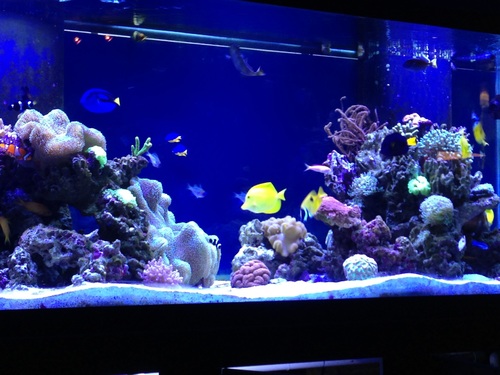
While fish are sensitive to temperature changes, species such as coral, shrimp, crabs, and starfish are much more sensitive to changes in their environment. Generally, you do not want your water temperature to fluctuate more than 2oF in a 24 hour period. If these species are subjected to very high temperatures or large temperature swings on a repeated basis, they will bleach (in the case of corals) or die. The temperature of the tank water may also impact dissolved oxygen levels -- as the temperature of the water increases, the amount of dissolved oxygen it can hold decreases. This concentration is also influenced by the number of fish, coral, and clean-up crew (bio-load) you keep in your tank. The higher the bio-load, the quicker the oxygen in the water will become depleted.
How Tank Size Impacts Temperature Fluctuations
The larger your tank is, the less its water temperature will fluctuate. This is because it takes longer to cool and heat larger volumes of water. So, for example, imagine shutting off your metal halide lighting at night. In a small nano cube tank that holds 10-20 gallons, the water temperature can change quite rapidly. However, if you have 150-200 gallons, the 12-14 hours the lights are off will not be long enough to significantly cause the large volume of water to cool. You also have to keep in mind that different areas of your tank may have different temperatures, depending what type of heating system you use and where the heater is placed. In-line heaters tend to be more efficient in regulating tank temperatures than submersible heaters, but the choice is really up to you.
How Can I Cool My Tank?
There are several things you can do to reduce the temperature of your aquarium water and keep it fairly constant. All work to varying degrees:
- If you have an air conditioner, make sure you are running it. This will go a long way in keeping the ambient temperature around the tank steady and cool. If you do not have central air, you may want to think about investing in a window unit for the room the tank is housed in.
- Make sure that no direct sunlight from windows is shining in on the tank. Even closing the blinds so afternoon sun will not heat up the room the tank is in will help cool the room by a few degrees. Avoiding direct sunlight will also reduce the risk of algae overgrowth in your tank.
- If it is possible for your specific animals, consider reducing the amount of time your lights are on during the day. This is particularly true if you are using metal halide lights, as these get tremendously hot while turned on. This method will not help with temperature fluctuations, but it will help if your water is getting too hot.
- Fans are helpful at reducing temperature when placed inside your tank hood. You can choose to purchase fans commercially or fit your tank with fans liberated from an old computer. Alternatively, you can remove a portion of your tank hood and aim a fan onto the surface of your water. Be sure to cover your tank with a net to keep acrobatic fish from jumping out and be aware that your water will evaporate more quickly.
- If you house your pumps in an enclosed stand under your tank, it will also raise the temperature of your water through the bottom of the tank. Fix this by opening up the stand door and placing a fan so it circulates the air underneath the tank.
- The most sure way of cooling a tank and the best way to prevent fluctuations (unfortunately, also the most expensive) is to purchase a chiller. These machines work to cool the water itself and are the best at keeping the water temperature constant. Chillers are available in two forms: drop-in and in-line. Drop-in chillers have coils that cool the water in a tank’s sump pump. In-line chillers depend on water getting pumped into the chiller, cooled, then sent back to the tank or sump. In-line chillers can be set up away from the tank (helpful if you have limited space by your tank) and connected by tubes to your tank. Chillers cost anywhere from $170 - $2000, depending on the size you need. A temperature controller is necessary to control the chiller. These cost between $50 and $200 and are available in both single and dual-stage models. A single-stage model will only work your chiller, but a dual-stage controller will work for both your heater and chiller. For the handy fish keeper, it is also possible to build your own chiller. Directions and diagrams are available on various websites.
Conclusion
Owning a saltwater aquarium is both a joy and a challenge. There s nothing quite as satisfying as having a miniature oceanic environment thriving right in your home, but it does take some work to keep it healthy. Keeping your water at a constant temperature is the best thing for your aquarium life – if the temperature fluctuates too much, it could cause your tank inhabitants to become stressed. By checking your temperature often and implementing the above techniques, you can ensure that your tank does not suffer from temperature-related stress or fatalities.

Learn about protein skimming, why it's important, and which aquarists should use it.

If you are new to the aquarium hobby you may not be familiar with the term "sump".
MOST RECENT ARTICLES

While snails are often viewed as a nuisance in the freshwater tank, they can serve a valuable purpose in the saltwater aquarium.

If you are looking for a unique inhabitant to add to your saltwater tank, consider the seahorse.